Why Burnout Is a Systemic Problem, Not a Personal One
By Diana Crowder 12/12/2025
Everyone’s obsessed with data — collecting it, analyzing it, visualizing it.
But the truth is, data is only half the story.
If data tells you what’s happening, documentation tells you how it’s happening — and without that, your data can’t tell you much at all.
In today’s AI-driven world, documentation has quietly become as valuable as data.
It’s the connective tissue that turns insight into action.
Data Without Context Is Just Numbers
Think about it: you can have perfect data on customer churn, response times, or approvals — but if you don’t know why those numbers look the way they do, the data is basically trivia.
Documentation gives your data context. It shows the workflow, the decisions, the dependencies, the “why behind the what.”
Without it, companies end up reacting to symptoms instead of fixing root causes.
That’s how you get endless dashboards, meetings, and KPIs that never change anything.
AI Doesn’t Just Need Data — It Needs Definition
AI can process data all day long, but if your processes aren’t documented, the machine can’t understand how your business actually operates.
It can’t connect your data to the actions that produced it.
So it makes assumptions — and assumptions, at scale, become very expensive.
Defined processes tell your AI what data means, where it comes from, and how it should be applied.
That’s what makes insights usable instead of just impressive.
Documentation Is the Hidden Knowledge Base
Every company has a “tribal knowledge” problem — the stuff that lives in people’s heads, in old emails, in someone’s private folder labeled “DO NOT DELETE.”
That information is priceless, but it’s invisible.
When you start documenting, you’re turning that invisible knowledge into structured intelligence — the same kind of resource that data warehouses did for raw numbers.
Documentation is your company’s human data set.
It captures experience, logic, and sequence — all the things AI can’t infer unless you define them first.
The Shift That’s Already Happening
Forward-thinking companies have realized that documentation isn’t busywork. It’s strategy.
They’re treating process definition the same way they treat data hygiene — something to maintain, not something to “get around to.”
They understand that every documented workflow is a new data point for the future — not for analytics this time, but for automation and AI readiness.
The ROI of Definition
When your documentation is structured and current, your data finally starts to work for you.
Analytics become actionable.
AI responses become accurate.
Teams make decisions faster because they understand how things actually connect.
Documentation doesn’t replace data — it unlocks it.
The EGT Approach
At EGT, we help companies build this connection point — documenting systems and processes so that data and AI can finally speak the same language.
Through onRETAINER, we create, organize, and secure the foundation your technology depends on.
Because in the new world of AI, clarity is currency.
And the companies who define their operations will be the ones who lead them.
Documentation is the New Data
By Diana Crowder 12/3/2025
Everyone’s obsessed with data — collecting it, analyzing it, visualizing it.
But the truth is, data is only half the story.
If data tells you what’s happening, documentation tells you how it’s happening — and without that, your data can’t tell you much at all.
In today’s AI-driven world, documentation has quietly become as valuable as data.
It’s the connective tissue that turns insight into action.
Data Without Context Is Just Numbers
Think about it: you can have perfect data on customer churn, response times, or approvals — but if you don’t know why those numbers look the way they do, the data is basically trivia.
Documentation gives your data context. It shows the workflow, the decisions, the dependencies, the “why behind the what.”
Without it, companies end up reacting to symptoms instead of fixing root causes.
That’s how you get endless dashboards, meetings, and KPIs that never change anything.
AI Doesn’t Just Need Data — It Needs Definition
AI can process data all day long, but if your processes aren’t documented, the machine can’t understand how your business actually operates.
It can’t connect your data to the actions that produced it.
So it makes assumptions — and assumptions, at scale, become very expensive.
Defined processes tell your AI what data means, where it comes from, and how it should be applied.
That’s what makes insights usable instead of just impressive.
Documentation Is the Hidden Knowledge Base
Every company has a “tribal knowledge” problem — the stuff that lives in people’s heads, in old emails, in someone’s private folder labeled “DO NOT DELETE.”
That information is priceless, but it’s invisible.
When you start documenting, you’re turning that invisible knowledge into structured intelligence — the same kind of resource that data warehouses did for raw numbers.
Documentation is your company’s human data set.
It captures experience, logic, and sequence — all the things AI can’t infer unless you define them first.
The Shift That’s Already Happening
Forward-thinking companies have realized that documentation isn’t busywork. It’s strategy.
They’re treating process definition the same way they treat data hygiene — something to maintain, not something to “get around to.”
They understand that every documented workflow is a new data point for the future — not for analytics this time, but for automation and AI readiness.
The ROI of Definition
When your documentation is structured and current, your data finally starts to work for you.
Analytics become actionable.
AI responses become accurate.
Teams make decisions faster because they understand how things actually connect.
Documentation doesn’t replace data — it unlocks it.
The EGT Approach
At EGT, we help companies build this connection point — documenting systems and processes so that data and AI can finally speak the same language.
Through onRETAINER, we create, organize, and secure the foundation your technology depends on.
Because in the new world of AI, clarity is currency.
And the companies who define their operations will be the ones who lead them.
AI Can't Read Your Mind - Or Your Mess
By Diana Crowder 11/20/25
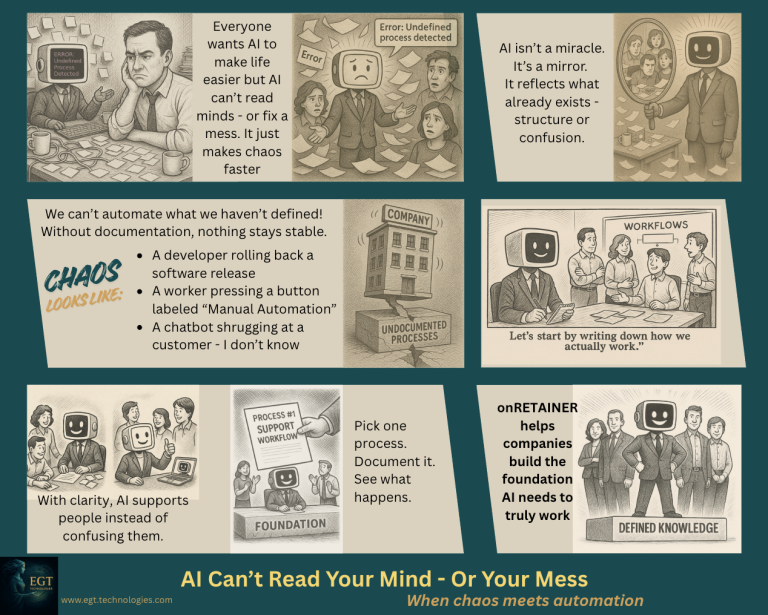
Everyone wants AI to make their lives easier: fewer errors, faster results, smarter everything.
But here’s the truth—AI can’t read your mind, and it can’t fix your mess.
If your processes are undocumented, your workflows inconsistent, and your team held together by memory and duct tape, AI won’t save you. It will just make the chaos faster.
AI isn’t a miracle. It’s a mirror. It reflects exactly what already exists in your organization—your structure, your documentation, your clarity (or lack of it). And if what’s underneath is a mess, the reflection will be, too.
The Foundation Problem
Every company talks about innovation, but few talk about foundation.
Your foundation is your documentation—your processes, your “how-to’s,” your rules of engagement between humans and systems. If that foundation is weak, nothing above it can stay stable.
You can’t automate what you haven’t defined. You can’t train an AI to support your people if it doesn’t even know how your systems work. You can’t expect consistent customer experiences when every department has its own version of “how things get done.”
A shaky foundation isn’t just inefficient. It’s expensive. It costs time, morale, and trust—inside and outside the company.
What Chaos Looks Like
You’ve seen it.
Software releases that need rollbacks because nobody’s sure which workflow was current.
“Automations” that require a human to push a button to make them run.
AI bots that can’t answer basic questions about the very systems they were built to support.
That’s not bad technology—it’s undefined process.
When you skip documentation, you don’t save time. You just transfer confusion from person to person until someone—usually your customer—pays the price.
What Happens When You Get It Right
When documentation becomes part of your foundation, everything changes.
AI finally has something to stand on. It can support your employees instead of confusing them. It can guide customers instead of frustrating them.
And when customers get real support from an AI—fast, clear, accurate—they don’t lose their flow. They keep moving, they trust your system, and they tell other people about it. That’s not hype. That’s alignment.
A well-documented company runs on defined knowledge instead of tribal knowledge. Everyone—human or machine—works from the same playbook.
The First Step
You don’t have to rebuild everything. Just start.
Pick one process. Document it clearly. See what happens.
You’ll uncover hidden steps, outdated workarounds, gaps nobody noticed. That’s the point. Each definition strengthens your foundation.
Commit to documenting how your company actually works—today.
That’s the moment your AI can finally start helping you instead of guessing for you.
The onRETAINER Difference
This is exactly why onRETAINER exists.
Because every company deserves access to the kind of foundational support that makes AI, automation, and human performance actually work together.
Whether you start with one department or a full roadmap, every piece of documentation becomes part of your long-term stability.
Each deliverable is securely stored, ready to build on—so your foundation grows with you, not against you.
AI can’t read your mind—or your mess.
But with the right foundation, it won’t have to.